


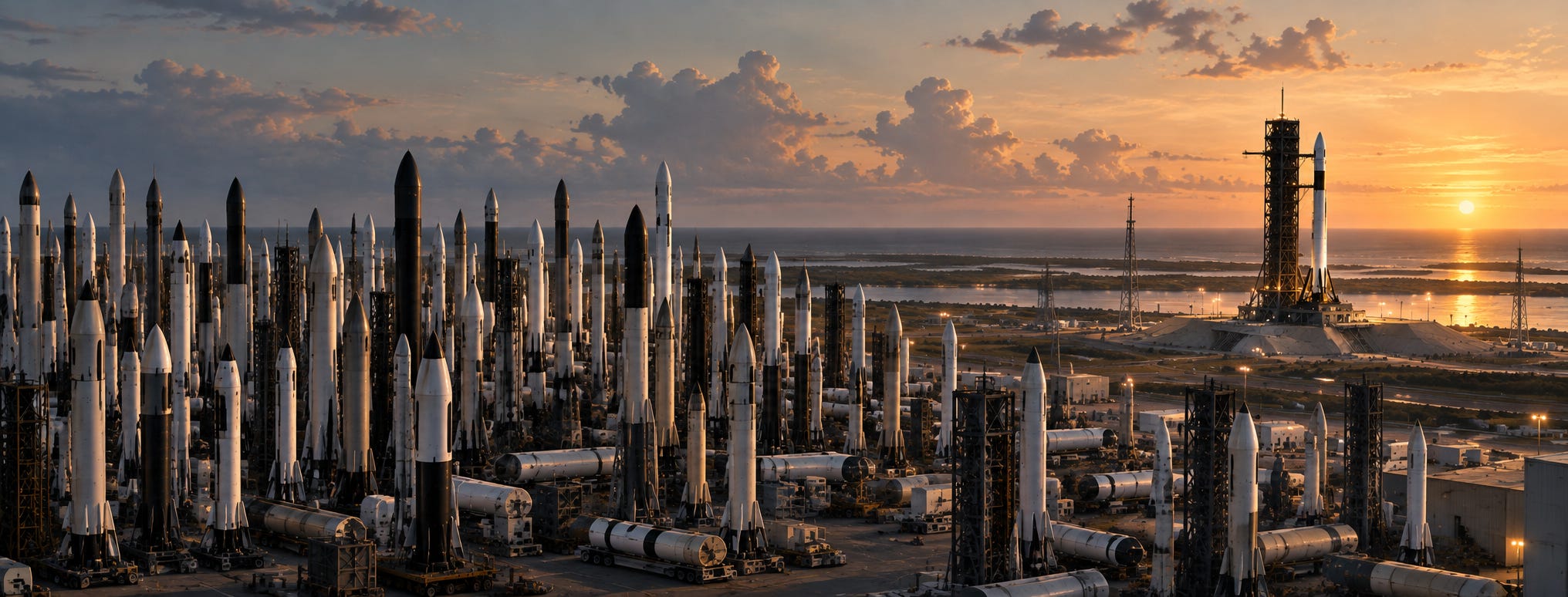
On August 20, the White House issued a new National Space Transportation Policy. Its headline goal is ambitious: By 2030, the nation’s spaceports “must grow to support more than 1,000 launches and reentries every year.” Last year the United States launched 193 rockets.
Can we achieve that many launches? Yes—but only if Congress lets spaceports charge for what they sell. Right now there are legal barriers to pricing scarce launch capacity.
From 2020 to 2025, launches at Cape Canaveral and Kennedy grew from 31 to 109. NASA’s inspector general projects 268 by 2030 and expects the Cape to approach capacity by late 2028. Commercial launches at federal spaceports have quadrupled since 2021. Gen. Chance Saltzman, then the Space Force’s chief of space operations, told Congress this summer that “our existing resources will fail if we don’t consider a cap” on launches. The spaceports are already crowded, yet policymakers want launches to quintuple.
Basic economics says that if there is excess demand for a scarce resource, its price will rise. The higher price does two jobs: rationing and signaling. Operators who can shift to an off-peak window or another site do so, and the slot goes to whoever values it most. And the premium on a prime Cape slot is the market’s estimate of what the marginal slot is worth. Economists call that premium a scarcity rent.
But the law prevents prices from doing their job. The Commercial Space Launch Act only permits federal agencies to charge commercial launch customers “direct costs,” meaning expenses the government “would not incur if there were no commercial launch or reentry effort.” The Pentagon got a narrow exception in the 2024 defense bill to recover some overhead, capped at 30 percent of direct costs and $5 million a year. That cap lapses on September 30. Afterward, it’s still cost recovery, just without the ceiling.
Cost to sellers is not the same thing as value to buyers. A cost-based fee doesn’t rise with demand, so it can’t ration, and it doesn’t reflect value, so it can’t signal. When the Space Force allocated pads in 2023, its launch chief described the challenge: “How can we cram them all in?” Instead of price adjustments, we get queueing. A payment moves money from buyer to seller; time spent waiting is simply consumed. Rationing by waiting is a pure social loss.
The obvious answer is to build more spaceports. Policymakers seem amenable. The new transportation policy orders a search for additional launch sites. The FAA has an open request for information on new spaceports, naming candidates from Georgia to Puerto Rico. The Space Force is courting Texas and Virginia and says it needs a third site for heavy rockets. This is a good start. But without prices to generate information and align incentives, we still don’t know how and where to expand capacity.
Some companies and states are trying to circumvent the federal bottlenecks by constructing spaceports themselves. Virginia has spent $176 million on its Wallops spaceport since 1995, Space Florida runs pads inside the Cape, and SpaceX built Starbase on private land. But the Florida and Virginia pads sit on federal property and depend on federal range services, so they wait for the same unpriced windows. Starbase is more promising. However, few companies have SpaceX’s deep pockets. And states that built with tax dollars instead of voluntary prices have little to show for it. New Mexico spent nearly $220 million on Spaceport America, yet its anchor tenant didn’t fly a paying customer until 2023. Camden County, Georgia, spent more than $11 million on a spaceport that never launched anything.
To its credit, the Trump administration recognizes the problem. Its new policy orders “fair and transparent cost recovery policies” and “range scheduling criteria to maximize efficient use of range resources for commercial users.” But different forms of cost recovery do not address high demand, and scheduling criteria are merely a rulebook for managing queues. (Worryingly, the rules for resolving a conflict between two customers aren’t published.) Non-price rationing almost always creates opaque, complex, and politicized decision processes. When a valuable asset is handed out at cost, the cheapest way to get it is to know someone, so the locus of competition moves from commercial to political margins.
Non-price rationing is discretionary by construction, and discretion in Washington tends to get captured by special interests. In contrast, a market price is visible and uniform. It doesn’t care who knows whom.
So what must be done? Congress should amend the Commercial Space Launch Act to allow spaceports to charge competitive rates for launch windows, instead of just costs. The simplest mechanism is an auction, similar to how we allocate spectrum. The law should require launch sites to publish what they charge and let them keep what they collect. Government spaceports won’t respond to profit the way private owners do, but revenue kept on site, rather than diverted to the Treasury, at least supplies the means to expand. Most importantly, policymakers must resist the urge to treat scarcity rents as a scandal demanding that they “do something.” The rent is how the next pad gets built.
The thousand-launch target will become a reality if we price our spaceports. Every congested window can pay for its own replacement. But keeping prices stuck at cost will needlessly delay launches. Long queues and lobbyists are not the path to space superiority.